If you’ve ever stared at a bathroom mirror long enough to notice it’s not just a flat, shiny piece of glass, you’re not alone. As a supplier of standard bathroom mirrors, I get asked this question at least a dozen times a week: “What’s the typical thickness of a standard bathroom mirror?” It sounds like a simple query, but the answer ties together construction, usability, and the small, unspoken details that make a bathroom mirror worth buying. Let’s break it down—not as a textbook answer, but as someone who’s spent years working with these mirrors, hearing from plumbers, renovators, and homeowners, and understanding why thickness matters more than you might think. Standard Bathroom Mirrors

First, let’s set the scene. When most people walk into a big-box store or scroll through online mirror listings, they see a range of numbers: 3mm, 4mm, 5mm, even 6mm. There’s no universal “standard” that every manufacturer follows, but there is a de facto industry standard that’s been the go-to for residential bathrooms for decades. For over 30 years, the typical thickness of a standard residential bathroom mirror is 4mm. That number isn’t pulled out of thin air—it’s the sweet spot that balances three critical factors: structural integrity, weight, and cost.
Let’s start with structural integrity, because that’s why no one wants a mirror that’s too thin. A 3mm mirror is the thinnest commonly sold bathroom mirror, and for good reason: it’s lightweight, cheap to ship, and easy to hang in tiny powder rooms or rental bathrooms where you don’t want to invest in something fancy. But thin mirrors have a flaw that’s hard to miss: they flex. If you lean on them, bump them with a towel rack, or even hang them on a wall that’s not perfectly flat, a 3mm mirror will warp slightly. That warping distorts reflections—you’ll notice your face looks a little stretched or wavy at the edges, which is annoying when you’re applying makeup, shaving, or trying to make sure your tie is straight. For primary bathrooms, where you spend 10+ minutes a day doing these tasks, that distortion isn’t acceptable.
Enter the 4mm mirror. It’s thick enough to eliminate that flex and warping for almost all standard residential installations. I’ve had contractors tell me they can hang a 4mm mirror on a standard drywall wall with just two mirror clips, no need for heavy-duty mounting, because the glass is rigid enough to hold its shape. We supply 4mm mirrors to hundreds of small-scale renovators who focus on mid-range homes, and the feedback is consistent: homeowners don’t complain about warped reflections, and the mirrors hold up through years of use. The only time a 4mm mirror starts to show its limits is in larger installations—like a mirror that spans an entire wall in a master bathroom. If a mirror is 6 feet wide or more, 4mm might still flex slightly, so we recommend upgrading to 5mm for those applications.
Now, why not go thicker? Why not make all standard bathroom mirrors 6mm, which is common in commercial settings? The answer comes down to two things: weight and cost. A 6mm mirror is 50% heavier than a 4mm mirror of the same size. Hanging a 6mm mirror requires special heavy-duty wall anchors, sometimes even reinforcing the drywall behind it, which adds time and cost to a renovation. For a small powder room mirror (like 18 inches by 24 inches), a 6mm mirror might weigh 8 pounds, while a 4mm mirror of the same size is just over 5 pounds. That might not sound like a big difference, but multiply that by 10 mirrors in a house, and you’re looking at extra hours of installation work, plus more expensive mounting hardware. Cost is another factor: 6mm mirror glass is roughly 30% more expensive than 4mm, so passing that on to consumers makes mid-range and budget-friendly homes less accessible. That’s why 4mm remains the residential standard—its balance of performance, weight, and price is unbeatable for most people.
But here’s where things get nuanced, because “standard” isn’t one-size-fits-all. Commercial bathroom mirrors—think of the ones in office buildings, restaurants, or gyms—often use 5mm or even 6mm thickness. Why? Commercial settings see more wear and tear: people bump them with carts, cleaning crews use heavy tools to wipe them down, and they’re often larger than residential mirrors. A thicker mirror is less likely to crack or chip if it’s hit, and it maintains its shape in high-traffic areas where many people are using it throughout the day. We supply a lot of commercial clients, and we consistently recommend 5mm for commercial bathroom spaces, because it’s durable enough for heavy use without being as heavy or expensive as 6mm.
I also get asked a lot about the old myth that thicker mirrors are “better” at reflecting light. That’s not true at all. The reflective layer on a standard mirror is a thin layer of silver (or aluminum, for more budget options) applied to the back of the glass, then sealed with a layer of paint or plastic to protect it. The thickness of the glass has almost no impact on how much light the mirror reflects—all that matters is the quality of the reflective layer and the smoothness of the glass surface. A 4mm mirror with a high-quality silver coating will reflect light better than a 6mm mirror with a cheap aluminum coating. Thickness is about structural performance, not optical performance, and that’s a key point I wish more people understood.
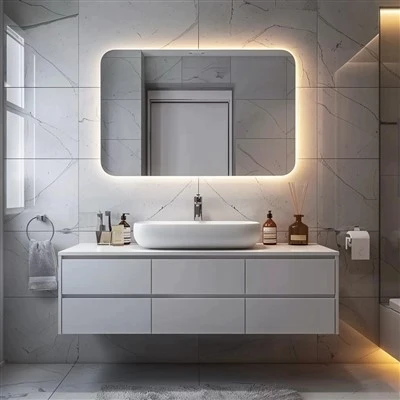
Another thing that surprises people: the standard thickness hasn’t changed much in recent decades. When I started in this business 25 years ago, 4mm was already the residential standard, and that’s still true today. The only shifts we’ve seen are in specialty mirrors: like backlit LED bathroom mirrors, which often use 5mm thickness because the LED frame adds weight, so a slightly thicker mirror prevents flex from the backlight’s mounting points. Or frameless bathroom mirrors, which are often 5mm because the lack of a frame means the edge needs to be thick enough to be durable when handled during installation. But for basic, wall-mounted, standard bathroom mirrors, 4mm is still the baseline.
I’ve also seen firsthand what happens when someone picks a mirror that’s too thin. A few years ago, we had a customer who bought a 3mm mirror for his master bathroom because it was $20 cheaper than a 4mm option. Within six months, he emailed us saying the mirror was warped so badly that his shaving line looked uneven, and he wanted to replace it. We sent him a 4mm mirror at a discount, and he told me the difference was night and day. That story stuck with me, because it’s a perfect example of why thickness matters beyond just a number on a spec sheet. For something you use every day, a small difference in thickness can make a big difference in daily comfort.
Now, let’s talk about how that standard thickness is measured, because that’s another detail that causes confusion. When suppliers list a mirror as 4mm thick, they’re referring to the actual thickness of the glass, not including the frame. Frameless mirrors will have a clean, 4mm edge, while framed mirrors add a small amount of thickness from the frame material (wood, metal, etc.) but the glass core is still 4mm. Some manufacturers will advertise “standard thickness” as 1/4 inch, which is roughly 6.35mm, but that’s an older measurement that’s become less common in the U.S. as metric measurements have become more widespread. Most modern suppliers, including us, use millimeters for mirror thickness, so don’t be confused if you see both numbers—just know that 4mm is the modern equivalent of the old 1/4 inch standard for residential mirrors.
If you’re in the market for a new bathroom mirror, here’s a quick guide to choosing the right thickness based on your space: For a small powder room, guest bathroom, or rental space where cost is a priority, 3mm works if you’re okay with minimal warping. For most primary bathrooms, 4mm is the sweet spot that balances performance and price. For large wall mirrors (6 feet or wider), commercial spaces, or frameless mirrors that will be handled frequently, upgrade to 5mm for extra durability. And if you need a mirror for a high-traffic commercial space like a gym or restaurant, 6mm is the most durable option, though it comes with extra installation costs.
As a supplier of standard bathroom mirrors, I’ve spent years testing different thicknesses, talking to installers and homeowners, and refining our inventory to make sure we’re offering what people actually need. The 4mm standard isn’t arbitrary—it’s a result of decades of feedback and testing, and it’s why so many plumbers and renovators specify 4mm mirrors without even thinking twice. It’s not the thinnest, it’s not the thickest, but it’s the one that works for most people most of the time.
At the end of the day, a bathroom mirror is more than just a functional piece of glass—it’s something you look at every morning, use to get ready for work or events, and that sets the tone for your bathroom’s design. Choosing the right thickness is a small, important decision that can save you from frustration down the line. If you’re looking for a high-quality standard bathroom mirror, whether for a residential renovation, a commercial project, or a small upgrade, don’t hesitate to reach out for more details on our inventory, sizing options, and custom orders.
LED Bathroom Mirrors References
- Glass Association of North America. (2021). Residential Mirror Specifications and Installation Guidelines. Retrieved from industry technical archives
- National Kitchen and Bath Association. (2022). Bathroom Design and Fixture Standards, 10th ed.
- International Code Council. (2020). International Residential Code: Glass and Glazing Requirements for Bathroom Applications.
- Mirror Manufacturers Association. (2023). Standard Thickness and Performance Metrics for Bathroom Mirrors.
Taizhou Zhiyuan Electronic Technology Co., Ltd.
As one of the most professional standard bathroom mirrors manufacturers and suppliers in China, we’re featured by quality products and good service. Please rest assured to wholesale customized standard bathroom mirrors from our factory. Welcome to contact us for free sample.
Address: Duqiao Town, Linhai City, Taizhou City, Zhejiang Province
E-mail: hsuming@zyledmirror.com.cn
WebSite: https://www.zyledmirror.com/
